
Strategy Stress-Test
Why Most Strategies Fail Before They Even Launch
Most strategies don’t fail because the thinking is wrong. They fail because the thinking has never been tested.
I’ve watched dozens of strategies presented in boardrooms over the past 30 years. The ones that work are not the ones with the cleanest slides. They’re the ones whose underlying logic has been deliberately stress-tested before anyone committed capital or talent to them.
This is what the Strategy Stress-Test is for. It is the part of a BUILD engagement where we stop projecting and start probing. We put your strategy in a structured sandbox and try to break it before the market does.
What we’re actually doing
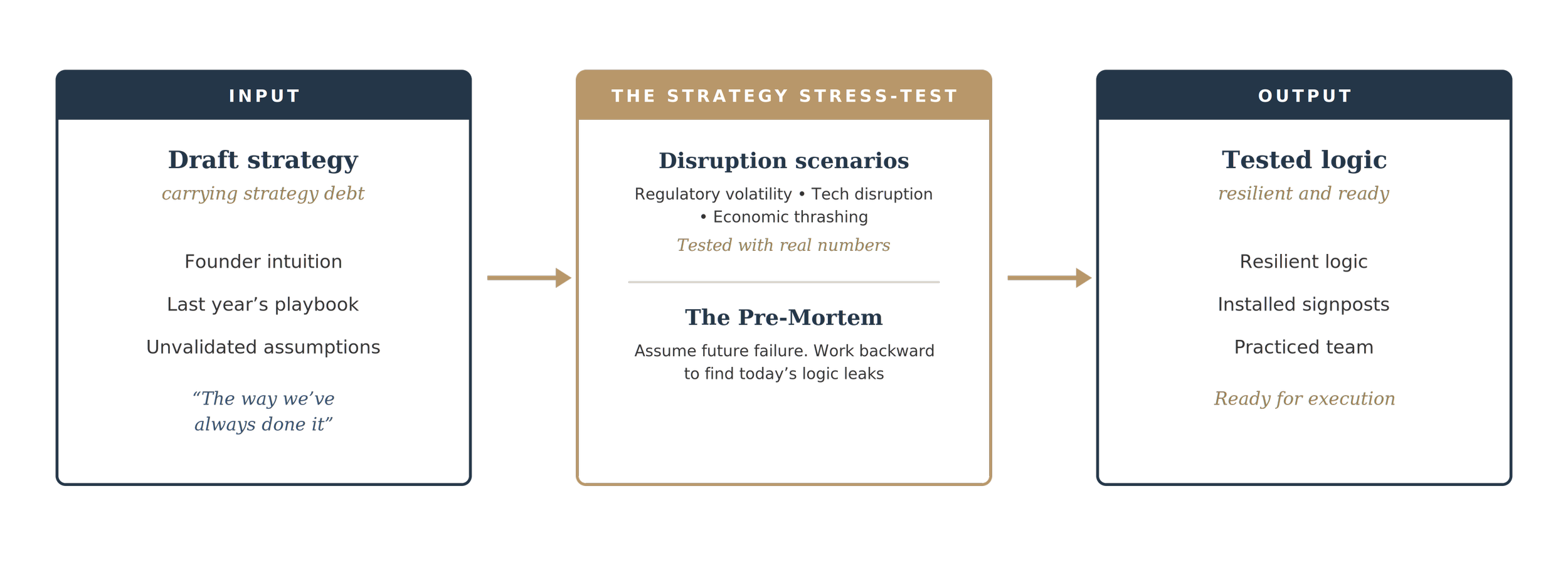
Most companies between $5M and $100M don’t fail for lack of a plan. They fail because of strategy debt. That is the accumulated weight of unvalidated assumptions that have been sitting around long enough to feel like truth. Founder intuition. Last year's playbook. "The way we have always done it." None of those have been tested against the world that exists right now.
In the Strategy Stress-Test, we red-team the strategy against the disruptions most likely to actually arrive. Three categories show up nearly every time.
Policy and regulatory volatility. What happens to your margins if a regulatory change hits in 48 hours? Most teams have never done that math.
Technological disruption. What if a competitor automates your primary value? AI is the obvious flavor right now, but the question is older than ChatGPT.
Economic thrashing. What if resource velocity drops 20% overnight, or capital costs spike, or a key supplier doubles its price?
These are not academic exercises. We use real numbers from the business and real moves a competitor could plausibly make. Then we watch what holds and what cracks. This forces the creation of a realistic and dynamic business model.
The Pre-Mortem
The other half of the Strategy Stress-Test is the Pre-Mortem. We assume something specific. Imagine it is two years from today, and your strategy has not worked. Not generically. Specifically. Then we work backward to identify the logic leaks that led to the failure.
This is not pessimism. It is the opposite. By naming the failure modes early, we build signposts into the operating plan. Early-warning systems. Triggers that tell the leadership team: "The assumption we made about X is breaking down, time to reassess." Most strategies have no such system. They run until the market makes the failure unmissable, by which point the response window has closed.
The discipline of identifying the breaking point in a sandbox before doing so in the field predates business strategy. Engineers do it with bridges. Pilots do it in simulators. Football teams do it in the preseason. We are simply applying the same logic to corporate strategy, where the cost of a quiet failure is just as high.
What you walk away with
When the Strategy Stress-Test is finished, you don’t have a static 50-page document. You have a tested logic of choice. You know which assumptions held up under pressure, which ones cracked, and what to watch for going forward. You have moved from hopeful forecasting to clinical readiness, which is the only sustainable advantage in volatile conditions.
Why does this matter more in 2026 than in 2019
Three forces have made strategy more fragile and faster than at any point in my career.
The first is AI. Not because every business will be replaced by it, but because the rate at which competitive moats can erode has compressed. A 5-year strategy assumes a stable competitive landscape over the same period. That assumption is no longer free.
The second is regulatory volatility. Industries that used to face one major rule change a decade ago now face several a year. Healthcare, finance, energy, and education are all running at higher policy beta than they used to. Tariffs, the closure of federal programs, and concerns over interest rates all weigh on the executive’s mind.
The third is supply chain and capital cost variability. The 20-year era of stable, cheap inputs is over. Plans built on its assumptions are inheriting a risk they did not price.
Each of these is a reason to test logic before you commit capital and talent to it. Not testing is no longer conservative. It is the riskier path.
If your current strategy has not gone through a Strategy Stress-Test, I would not be confident in it. Not because the thinking is wrong. The thinking is probably fine. But fine thinking that has never met resistance is an opinion backed by confidence. Markets do not respect confidence. They respect tested logic.
If you want to talk about whether your strategy is ready for a Strategy Stress-Test, schedule a Fit Call.
Want to keep this? Download the PDF version.